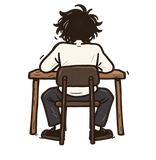
A monastery chronicle discovered on a small planet in the outer regions of the galaxy. The name of the monastery is illegible. The recorder's name was Asano Ren, but he referred to himself only as “the gatekeeper.” Seventeen people once lived at the monastery. Few records remain of the god they believed in, the religion they practiced, or the species to which they belonged. According to the records, texts from the Zen Buddhist tradition of an island nation in East Asia, where early humanity had lived, were preserved there. The final portion of the chronicle speaks more of weather, food, and broken equipment than of religious revelation.
Today, a star disappeared from the western sky. The priest said that the star had not disappeared, but that communication between the star and us had been lost. His words were more accurate and more sorrowful. If the star had died, something had happened to the star. If communication had been lost, something had happened to us.
We rang the evening bell. Since sound cannot travel through a vacuum, the bell rang only inside the monastery. In the past, pilgrim ships received the sound of the bell in orbit and converted it into music. Now the pilgrim ships no longer come. We continue to ring the bell. The abbot said that a bell did not need an audience.
The following day, the third sunlamp in the food cultivation chamber went out. Two spare lamps remained. The abbot told us to turn one on and keep the other in reserve. One novice said that to preserve the last spare lamp, we should also turn off the one we had just lit.
We voted. Twelve voted to save the vegetables, and four voted to preserve one lamp for the future. I abstained. I thought a gatekeeper merely opened and closed the gate, without deciding which side was outside. I now know that abstention was also a choice. The vegetables survived. The number of spare lamps decreased.
That winter, the communications station received the Declaration Denying Galactic Extinction. It stated that the civilization of our galaxy was not undergoing extinction. The abbot posted the declaration on the dining hall wall. It was not to reassure the others. Paper with writing on it had become scarce. We wrote the potato rations on the back of the declaration. Civilization was not undergoing extinction. There were two potatoes per person.
A few years later, the abbot died. According to the monastery's rules, his body had to be sent into a star. The launching device required enough energy to sustain one novice through the winter. We could not ask the abbot what he wanted. One passage in his sermons stated that duties to the living were more important than rituals for the dead. Another passage in the same sermons stated that without observing rituals, the lives of the living would also lose their direction. We argued over which passage expressed his final wishes.
The abbot waited in the freezer for fourteen months. Maintaining the freezer consumed more energy than launching him would have. Eventually, we buried him in the soil behind the monastery. There were no decomposing organisms in the soil of this planet. The abbot's body did not decay. No one knew exactly what the act of burial meant. Still, we covered him with soil.
Three novices departed for the central regions. They said they would seek help and return. None came back. We do not know whether the passage closed, whether they decided to remain after arriving, or whether they died on the way. Those who remained did not call them traitors.
The novices who arrived later did not know the faces of those who had left. To them, the three were figures from an old story who had disappeared with food and fuel. Remembering goodwill required a witness; remembering resentment required only a sentence. I removed the word “escape” from the chronicle and wrote “departure” instead. I do not know whether I corrected the facts or corrected history.
The last novice died of a fever. The medical device was functioning, but it had to send its diagnosis to a central computational entity. Communications with the center had been severed nineteen years earlier. The device repeated the same sentence while waiting for a response. “Please wait a moment.” He waited for three days. Shortly before he died, he asked me, “Are we being punished?” I said no. Punishment requires someone to administer it. Until now, all we had discovered were causes. Causes do not become angry, nor do they forgive. A cause meant only that one thing had brought about another. He asked again, “Then does none of this have any meaning?” I could not answer. Even saying that something had no meaning required someone to make that judgment.
Now I am alone in the monastery. Every morning, I open the gate. There is no atmosphere outside, so no one can walk in. In the evening, I close it. The air would not escape even if I left it open. There is another airtight door beyond the gate. The first gate is unnecessary. Still, I open it. While I am opening the gate, I am still the gatekeeper.
The spare lamp we had kept was switched on long ago. Today, the last sunlamp went out. The vegetable cultivation chamber is dark. The seeds remain, but there is no light to make them sprout. I have not thrown away the seeds. To throw them away would require certainty that they would never grow again. Our civilization must have ended in much the same way. No one was certain enough to abandon the last possibility. And so the devices that preserved possibilities consumed living things one by one. I spent a long time considering whom I should blame. Those who used the stars, those who built the passages, those who entered missing energy in their accounts as assets to be received, the politician who believed those accounts and urged further consumption, citizens who did not believe the warnings, people who gave warnings but did not change the way they lived. The list grew endlessly longer. My name was on it too.
Until today, I rang the bell, opened the gate, and heated a monastery that was no longer needed. It was not because preserving tradition mattered more than extinction. It was because I did not know who I would be if I abandoned tradition. Civilization, too, lost the place where it could live because it did not want to lose its sense of who it was.
I leave this as the last record. We were not murdered. We tried to prolong life for so long that we became unable even to die. We did not come to an end because we were evil. We came to an end because we could not decide which of the things we loved to abandon first.
I ring the evening bell. Today, I will ring it only once. Not so that someone will hear it. To record that it is possible to ring it once and then stop.