
When I Rotated a Black Hole 90 Degrees
A Thought Experiment on Up and Down in the Universe, Closed Systems, and Storage Space
From the Making of A Dictionary of Galactic Extinction
November 3, 2026
While watching a video about black holes, I noticed something strange. A bright band of light stretched across a dark circle, and above it rose another curve. It looked as though two rings had been placed at right angles to each other. An accretion disk can form around a black hole. It is a disk created by matter rotating as it falls toward the black hole. The black hole's powerful gravity, however, also bends the paths of light coming from behind it. As a result, the far side of the disk can appear to rise above or below the black hole.
What first interested me were those two curves. Which was the actual disk, and which was an image produced by the bending of light? Why did one lie horizontally while the other rose vertically? What would they look like if I changed my position of observation? To understand this, I created images of a black hole viewed from four different directions. I designated the frontal view as 0 degrees and placed it alongside views from 90 degrees to the right, 90 degrees to the left, and 180 degrees from the rear.
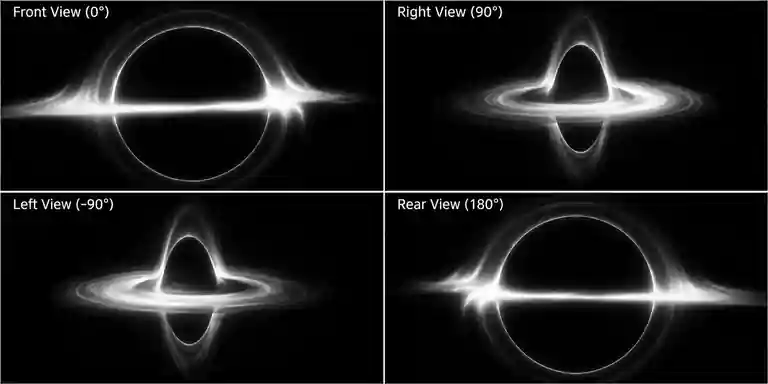
〈Conceptual images created to compare a black hole's accretion disk and gravitational lensing effect from different viewing directions.〉
As I compared the four images, I initially wanted to confirm a simple fact: there was only one actual disk, yet the bending of light could make several structures appear to overlap. But the longer I examined the images, the more questions arose. Why do we accept a horizontally positioned ring as normal while finding a vertically rising ring strange? Must a disk necessarily rotate horizontally? If so, what determines horizontal and vertical in the universe? From that point, my thoughts began to move in another direction.
Earth has a North Pole and a South Pole. The Sun also has an axis of rotation. We use that axis to define an equatorial plane and distinguish north from south. The rotational axis of a celestial body is a physical direction that can actually be measured. But what if one celestial body's axis were tilted 90 degrees relative to another's? I thought of a billiard ball. When another ball strikes a spinning billiard ball, its axis of rotation may change, or its direction of rotation may reverse. The same can happen to a planet. Suppose a planet rotating counterclockwise receives an enormous impact and begins rotating clockwise. If its axis of rotation has flipped 180 degrees, the line along which the axis lies remains the same, but the direction of rotation is exactly reversed. Seen from outside, the same sphere is still rotating around the same axis. Only the direction of rotation has changed. Then what is the basis on which we call the two ends of that axis the North Pole and the South Pole? Which side is up, and which is down?
An axis of rotation represents the physical state of a celestial body, but calling one end of that axis "up" involves the observer's frame of reference. Even saying that a celestial body has been turned upside down makes sense only after we establish the reference against which it has been overturned. I have found this question strange for a long time. We are told that there is no absolute up or down in the universe. For human beings who live on Earth and take up and down so completely for granted, this is difficult to understand intuitively. So I imagined a sphere.
There is a large hollow sphere, and a living creature inhabits its interior. Inside the sphere, there is no external gravitational reference to determine up or down. The creature moves and rotates freely. If an observer existed outside the sphere, that observer could see which direction the creature was facing. But the creature inside would have no way to compare its orientation with an absolute up or down. Even if it appeared to an outside observer to be hanging upside down, the very concept of being upside down might have no meaning for the creature itself.
What concerns me here is not the creature's orientation. The question is whether a creature inside the sphere could know the overall structure of the sphere it inhabits. It could observe its surroundings, measure distances, and calculate the paths taken by light. Given sufficient technology and time, it might discover much about the geometric properties of the space in which it lives. Even so, the experience of viewing its own space from outside might remain impossible. This resembles our situation when we observe the universe.
We are inside the universe. We observe light arriving from space, calculate the distances and motions of celestial bodies, and reconstruct the history of the universe. Yet we have never looked down on the entire universe from outside. I had a similar thought when I first saw a map of the cosmic microwave background. That map is not a photograph of the universe taken from outside. It arranges the cosmic microwave background radiation reaching an observer from every direction and projects it onto a flat surface. We assign a top and bottom to the oval map and distinguish its center from its edges.
But the direction marked as the top of that map is not necessarily the top of the universe itself. What we see is not the universe's exterior appearance but a record of light that has reached an observer within it. Thinking about this brought me back to a question I had long carried with me. Is the absence of up and down a property of the universe itself, or is it related to the way we perceive the universe? Of course, this question combines two different problems. The absence of an absolute up or down is a matter of coordinates and direction. How much we can know about the overall structure of the universe is a matter of observation and geometry. The two problems do not necessarily have the same answer.
It was the second problem that interested me. We live within three spatial dimensions. We move forward and backward, left and right, up and down, and use those three directions to specify the position of an object. But what if there were another spatial dimension? We can imagine a creature capable of living only on the two-dimensional surface of a sphere. That creature could move along its world, but it could not see the entire spherical surface from outside as we can look at a sphere. From a space of one higher dimension, we can view that spherical surface as a single object.
What would happen if we applied this idea to our universe? If the three-dimensional space we experience were related to a higher-dimensional space, we might have to understand the structure of the universe from a direction we had never previously considered. Of course, the existence of such additional spatial dimensions has not been confirmed. Even if an additional dimension were discovered, it would not automatically imply an outside to the universe or an absolute up and down. I am not trying to propose a new cosmological theory here. The question that has occupied me for so long is somewhat simpler. If we do not know the overall structure of the universe, might the reason lie not merely in the limitations of our observational instruments, but in the limitations of the space we inhabit and the region accessible to observation?
This question connects with two concepts in A Dictionary of Galactic Extinction, the novel I am writing. One is the closed system, and the other is storage space. In the novel, galactic civilization discovers a photon deficit, a phenomenon in which light appears to disappear. A deficit emerges that repeated observations and calculations cannot explain, and the problem expands to the processes by which energy and matter are transferred. The civilization does not readily abandon the law of conservation of energy. If the energy that appears to have vanished has not actually ceased to exist, where is it?
Following this question soon leads to the problem of closed systems. A closed system is a physical system that does not exchange matter with its surroundings but can exchange energy. A system that exchanges neither matter nor energy is an isolated system. But to determine whether a system is closed, we must first know its boundary. If we do not know what lies beyond that boundary, can we rule out the possibility that a region we believe to be a completely closed system is actually part of a larger physical system? A problem of language also arises here. If we define the universe as everything that exists, then, by definition, there is no outside to the universe. Whatever we discover can simply be included within it.
Yet that definition does not prove that the region we can presently observe constitutes all of existence. The universe as a whole and the observable universe are not the same thing. The section titled "Closed System" in A Dictionary of Galactic Extinction deals with precisely this problem. The novel does not declare that the universe has an outside. Nor does it prove that no outside exists. It shows the process by which a galactic civilization begins to question the boundaries of the physical system it thought it understood. I did not want to provide a definitive answer to this problem. Perhaps the fact that the answer is unknown is the very starting point of the work.
Storage space is a fictional assumption that takes this idea one step further. In A Dictionary of Galactic Extinction, the last scientist creates a new causal domain connected to existing spacetime. The connection visible from outside is small, but the space within it cannot be explained by the size of its entrance alone. This space is not an enormous warehouse located somewhere in the universe. Nor is it a room hidden beneath a planet's surface or behind a black hole. It is a domain connected to existing spacetime, yet one that cannot readily be understood through our familiar concepts of spatial size and distance.
In the novel, the energy previously recorded as missing is connected to this storage space. The galactic civilization concluded that energy had disappeared from the region it could observe, but considering a larger physical system makes another interpretation possible. This is not a scientifically verified physical mechanism but a spacetime structure devised for the novel. To explain how energy moves and accumulates within it, the work must assume additional physical conditions. Yet whenever I think about this storage space, a question I have carried for many years returns. How much do we really know about what space is?
If an entrance before our eyes is small, must the space connected to it also be small? Must the distances and volumes we measure behave in the same way in other domains to which we have no access? And, above all, can we treat a domain we cannot observe as identical to one that does not exist? Physics is not a discipline that arbitrarily declares unobservable things to exist. Acknowledging the limits of observation and claiming that something exists beyond those limits are entirely different matters. I am aware of that distinction.
That is why I did not resolve this problem in the novel. I left open the final explanation of how far the closed system actually extends, how storage space relates to the existing universe, and what kind of space the whole should be called. The civilization in the novel, too, is ultimately unable to close the entire gap between the phenomena it has discovered and the world it believes it understands. Today, while examining images of a black hole from four directions, I found myself returning to an old line of thought. At first, I had simply wondered which of the two curves represented the actual accretion disk. That question led to the basis of up and down, to the observer's position, and then to the overall structure of the universe. And from there, it returned once again to closed systems and storage space.
The images of the black hole did not lead me to discover a problem I had never considered before. Instead, they provided a concrete starting point from which I could think about that problem again. Changing the direction of observation in the four images does not alter the actual structure of the black hole. What changes is how it appears to the observer. What, then, about the world we call the universe? Even if we change the direction from which we look, improve our observational instruments, and refine our calculations, there may still be domains beyond our reach. We do not know whether those domains actually exist or whether we will ever be able to know of them.
What I have been thinking about for so long is not a claim that up and down exist in the universe. It is the question of whether the very fact that we are inside the universe might determine what we can and cannot know about the universe as a whole. The thought experiment that began with rotating a black hole 90 degrees ultimately returned to that old question.